Skill Vector Matching & AI Resume Parsing: How Neural Networks Evaluate Candidates Beyond Keywords
# Skill Vector Matching & AI Resume Parsing: How Neural Networks Evaluate Candidates Beyond Keywords
For decades, the standard resume screening workflow in corporate recruiting has relied on basic string search: recruiters or legacy Applicant Tracking Systems (ATS) would search a database for rigid keywords like "Python", "Kubernetes", or "B2B Sales".
This primitive approach created two massive structural failures in recruitment: 1. **Keyword Stuffing & Gaming:** Candidates who artificially loaded their resumes with buzzwords ranked highest, regardless of actual competency or practical depth. 2. **False Negatives & Overlooked Talent:** Highly skilled candidates who phrased their experience differently (e.g., describing "building low-latency distributed microservices" instead of repeating "Golang developer") were automatically discarded.
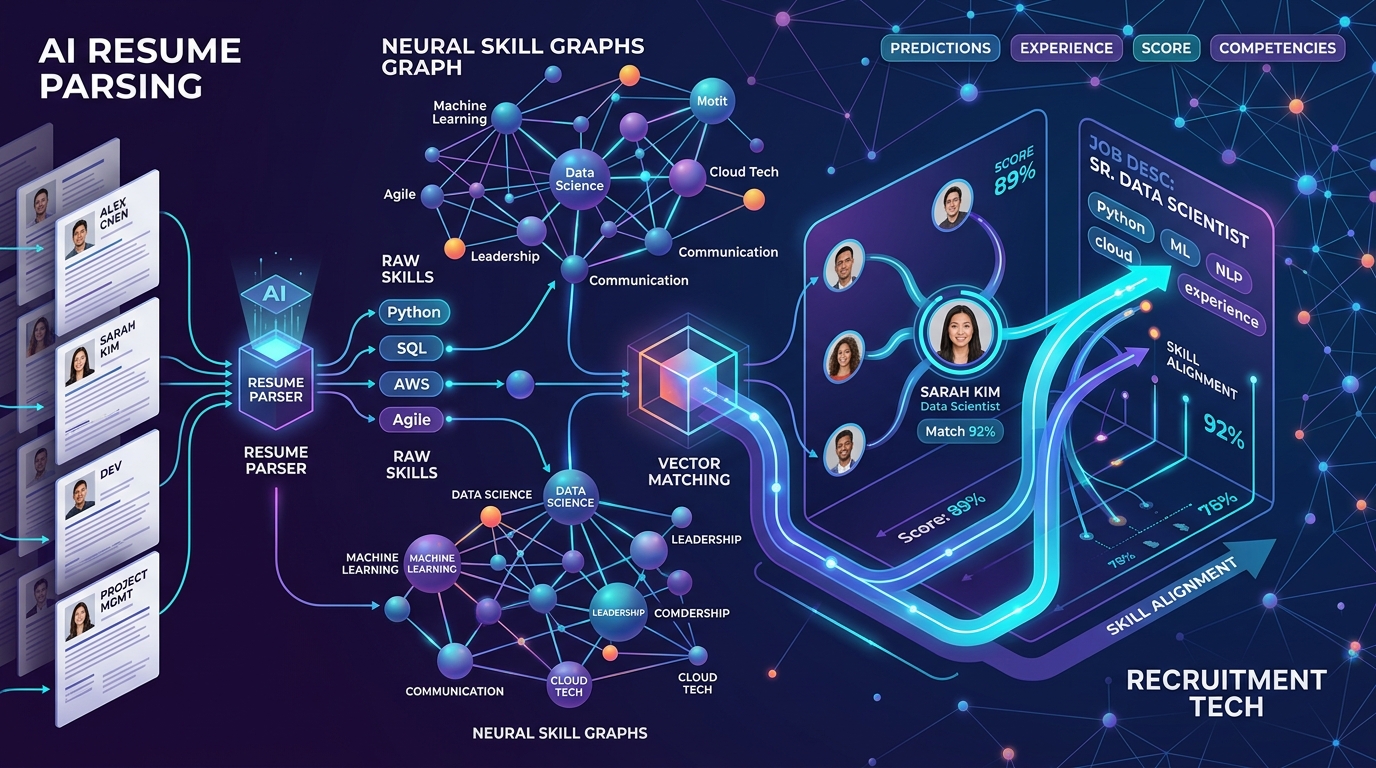
Modern AI recruiting platforms like Hireytics solve this through **Skill Vector Matching** and **Neural OCR Resume Parsing**. Learn how our Candidate Screening Engine applies multi-dimensional semantic analysis.
What Is Skill Vector Matching?
Skill Vector Matching is an AI architecture that represents a candidate's skills, professional background, and accomplishments as mathematical coordinates (vectors) in a high-dimensional semantic space.
Instead of asking *"Does the word 'PostgreSQL' exist in this PDF?"*, vector embeddings evaluate: * **Semantic Proximity:** Understanding that experience with *Kafka, RabbitMQ, and event streaming* indicates distributed messaging capabilities. * **Contextual Seniority:** Differentiating between a candidate who *configured a tool once* versus an engineer who *architected a multi-region production deployment*. * **Skill Synergy & Trajectory:** Evaluating how complementary skills combine to predict success in a target role.
How Neural OCR and Vector Parsing Works Step-by-Step
1. Document Ingestion & Optical Character Recognition (OCR) Resumes arrive in unpredictable layouts—multi-column PDF tables, non-standard fonts, scanned graphics, and portfolio exports. Modern OCR engines extract layout hierarchy, section boundaries, and project timelines without breaking text flow.
2. Entity Extraction & Context Normalization Natural language models identify organizations, titles, tenures, certifications, and technical deliverables, converting unstructured paragraphs into structured competency models.
3. High-Dimensional Vector Embedding The structured applicant profile is transformed into a dense mathematical vector. Concurrently, the hiring team's job description and rubric criteria are embedded in the exact same vector space.
4. Cosine Similarity & Rubric Proximity Scoring The platform calculates the multi-dimensional distance between the candidate vector and the role rubric. The result is a nuanced, objective match score (e.g., 94% alignment) backed by transparent explanations.
Why Vector Matching Eliminates Hiring Bias
Traditional human resume skimming often falls prey to unconscious heuristics—such as favoring specific alma maters or recognizable brand names over demonstrated skill.
Skill vector matching isolates verified deliverables, technical capabilities, and project scope. When combined with Hireytics' blind screening mode, candidate names, addresses, and demographic indicators can be completely masked during initial ranking.
Explore our AI Recruiting Suite to see automated qualification in real-time.
Key Takeaways for Talent Leaders
- **Stop filtering by exact keywords:** Transition to semantic vector evaluation to surface overlooked top performers.
- **Insist on explainability:*Ensure your AI screening tool provides clear citations and transparent score breakdowns.
- **Combine Vector Screening with Voice Verification:*Verify claimed resume skills with asynchronous voice screening.
Check out our Pricing Plans or begin a Free 14-Day Trial to test neural resume parsing today.

Saad Shahrukh
Founder & Head of Product at Hireytics
Saad Shahrukh is the Founder & Head of Product at Hireytics, building next-generation AI recruiting systems, automated acoustic voice screening, and institutional hiring memory with Recall.